















NUPRC weighs crude swap as modular refineries reject local supply
- August 15, 2026

The Nigerian Upstream Petroleum Regulatory Commission (NUPRC) is considering a crude oil swap arrangement to address the logistical and commercial barriers limiting domestic refineries’ access to locally produced crude oil.
Oritsemeyiwa Eyesan, Chief Executive Officer of the commission, said the proposed arrangement would allow oil producers with domestic crude supply obligations to exchange delivery locations, potentially reducing transportation costs and improving feedstock availability for local refineries.
Eyesan disclosed this during a courtesy visit to the Nigerian Midstream and Downstream Petroleum Regulatory Authority (NMDPRA) in Abuja.
Under the proposed arrangement, a producer with an obligation to supply crude close to an export terminal could swap that obligation with another producer whose crude is closer to a domestic refinery.
“How the swap works is that I have an obligation somewhere and I am close to an export facility. Somebody else has an obligation inland and his own facility is close to a domestic offtaker. Instead of trying to move from one end to the other, we just agree on a swap arrangement and there is a mechanism for them netting off,” Eyesan said.
She said discussions on crude swaps were still at an early stage, adding that the commission would work with the NMDPRA to finalise the framework.
The proposal comes as modular refineries continue to complain that the commercial terms attached to the Domestic Crude Supply Obligation (DCSO) make it difficult for them to take up crude allocated through the regulatory framework.
The Crude Oil Refinery Owners Association of Nigeria (CORAN) said its members did not lift crude under the DCSO arrangement in the second quarter of 2026 because the prevailing pricing structure made the transactions commercially unattractive.
Eche Idoko, spokesman for CORAN, said the use of international pricing benchmarks such as Platts, Brent and West Texas Intermediate had made crude too expensive for modular refineries, particularly because the refiners also bear the cost of evacuating crude from producing assets to their facilities.
“The smaller refineries couldn’t take crude because of the issues we have outlined. The commercial terms were not realistic,” Idoko said.
The dispute highlights a fundamental weakness in Nigeria’s attempt to force more locally produced crude into domestic refining: the existence of a regulatory obligation does not necessarily translate into a commercially viable transaction.
Under the Petroleum Industry Act, crude producers are subject to the DCSO, while transactions between producers and domestic refiners are conducted on a willing-buyer, willing-seller basis.
The NUPRC’s second-quarter 2026 data showed that 53.7 million barrels of crude oil and condensate were supplied to local refiners between April and June, representing 97.4 per cent performance against the commission’s obligations for the period.
However, the headline compliance figure masks a significant difference between crude volumes offered to refiners and volumes actually lifted.
In April, producers were allocated 18.13 million barrels but offered 19.31 million barrels to refiners. Actual supply reached 20.88 million barrels, representing 114.9 per cent performance against the allocation.
In May, producers were allocated 18.78 million barrels and offered 23.19 million barrels, but actual supply fell to 14.23 million barrels, representing 75.8 per cent compliance.
In June, 18.17 million barrels were allocated while producers offered 26.84 million barrels. Actual supply stood at 18.61 million barrels, equivalent to 102.4 per cent performance.
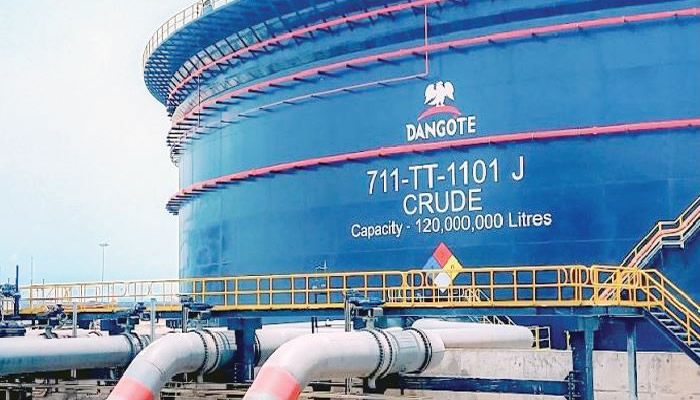
The data also showed the concentration of the domestic crude programme around the Dangote Petroleum Refinery.
Of the 68.1 million barrels offered to domestic refiners during the quarter, 98 per cent was offered to the Dangote refinery. The facility accepted 52.6 million barrels, or 78 per cent of the crude offered to it.
The NUPRC did not indicate that any other refinery received crude under the DCSO during the quarter.
For modular refiners, the problem is not simply the availability of crude on paper but whether the price and delivery terms make it economical to process.
Idoko said modular refiners often purchase crude directly from producing assets and assume responsibility for transportation, evacuation, handling and security.
He argued that pricing such crude directly against international benchmarks without adjusting for the actual domestic delivery point could result in refiners effectively paying for logistics twice.
A refinery collecting crude at a wellhead or production facility, for example, could be charged a benchmark-derived price that incorporates international freight and insurance assumptions while still paying separately to evacuate the crude to its refinery.
CORAN is seeking a domestic crude pricing mechanism that reflects the actual point of delivery and removes logistics costs that are not incurred by producers.
The association’s position points to a broader structural problem in Nigeria’s emerging refining market, the location of a refinery can be as important as its processing capacity.
Access to feedstock and crude evacuation infrastructure has shaped the economics of Nigeria’s modular refining industry.
The 11,000-barrel-per-day Aradel refinery at Ogbele and the 5,000-bpd Waltersmith refinery at Ibigwe had an important advantage because they were integrated with oil-producing assets, providing a relatively assured source of feedstock.
In 2023, crude from Decklar Resources’ Oza field was trucked to the Edo Refinery and Duport Midstream refinery which showed that producers and small refiners could establish commercial supply arrangements outside the formal DCSO mechanism when logistics and pricing were workable.