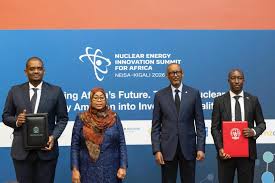
The Nuclear Energy Innovation Summit for Africa (NEISA 2026) concluded Thursday with renewed calls for expanding nuclear power across the continent, but delegates left without concrete breakthroughs on financing mechanisms for future projects.
The four-day summit held in Kigali took off on Monday and was expected to establish a nuclear energy financing framework, according to the organisers. However, despite growing enthusiasm for nuclear energy as a tool for Africa’s economic transformation, the summit ended without major commitments from international lenders or financial institutions.
Speaking at the summit, Director General of the International Atomic Energy Agency (IAEA) Rafael Mariano Grossi warned that existing global financing structures are slowing the development of nuclear energy infrastructure, particularly in Africa where energy demand continues to rise rapidly.
“We know that we have a problem, but we are certainly at it, and it is also possible to be improved. This is where the responsibility of the international community comes in,” Grossi said.
He argued that nuclear energy should be treated not only as a technological solution, but also as a development and financing priority requiring specialized investment frameworks.
“We need to be very open to see that nuclear energy has to respond to energy needs and finance. And we need a very distinct, separate nuclear energy financing approach,” he added.
Tanzanian President Samia Suluhu Hassan also called for stronger cooperation between African nations and international partners to accelerate peaceful and sustainable nuclear energy development.
Hassan described the summit as a key platform to help Africa move “from ambition to implementation” in building sustainable energy systems.
She said Tanzania’s rising electricity demand — fueled by industrial expansion, urbanization and digital transformation under the Tanzania Development Vision 2050 — requires diversified long-term energy solutions.
“It is in this context that Tanzania is advancing consideration of nuclear energy as part of our long-term energy diversification strategy,” Hassan said, citing interest in emerging technologies such as small modular reactors and micro modular reactors.
On the sidelines of the summit, Hassan met with Rwandan President Paul Kagame, where the two leaders witnessed the signing of a memorandum of understanding on energy cooperation between Tanzania and Rwanda.